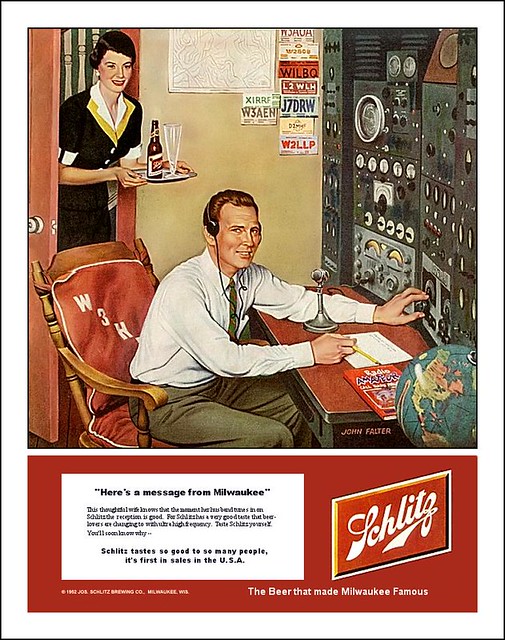
Weather and Radio

There is a long association between weather and radio in general and Amateur Radio in particular. When broadcast radio started to become in general use, people began to rely on it for local weather reports. Amateur Radio was also found to be useful for spreading weather reports, not only locally but over long distances. One topic of conversation over the radio has always been the weather. Many QSOs include the local weather. It does go deeper than just chatting, however. Hams are concerned about the weather. If thunderstorms come along, it is bad to have your equipment hooked up in case of a lightening strike. Hail and high winds can take down antennas. Trees can come down during storms and flooding can cause all kinds of havoc.

Amateur Radio operators (hams) have been and still are relied upon to provide back-up communications in emergencies and a lot of emergencies are weather related. Even if a ham cannot get to an area and assist with communications they can still be of value by reporting local conditions. A lot of hams have weather stations in their yard and can report things such as temperatures, pressure changes and precipitation totals to the NWS. There are phone apps that allow you to report (mPing is one example and is free) local conditions. What do you do if your cell service is out? Well there are a lot of clubs out there that hold nets when there is severe weather. You can log into a net on a repeater and report. They usually have a back-up plan in the event that repeaters are down. There are also weather nets on the HF bands where you can report conditions. A lot of options exist.

At the extreme end, there are hams who go out spotting bad storms such as tornados. anyway, here is a list of some resources to use if you want to get into weather reporting or learn more about the weather:

http://www.weather.gov is the National Weather Service website

https://www.weather.gov/SKYWARN This is the official NWS Skywarn page

https://www.weather.gov/skywarn/wfo_links This is a link to find local spotter classes in your area

https://www.meted.ucar.edu/education_training/course/23 This is a link to online spotter training

https://www.skywarn.org/local-groups/ And finally a link to locate groups in your area.

I hope this has been useful information to someone out there. 🙂
The Attraction: Why I like ham radio

A person could ask what do I find attractive about Amateur radio. To answer that we will have to delve into the past. When I was a kid I used to sneak a transistor radio into my bed at night and listen to AM radio stations, including WBZ out of Boston. The very idea of hearing stations from across the country was mystical. I found back in 1998, that ham radio had the same sort of magic but now I could reply to and interact with the disembodied voices. When I first started I was impressed with the friendly people who were very helpful to a newby. Some of them are gone now but will always remain in my memory.

These days I use CW on the HF bands and occasionally SSB when there is a special event station I want to work. I belong to a couple of CW clubs on the air : FISTS which is the Morse Code Preservation Society and SKCC which is the Straight Key Century Club which promotes the use of manual telegraphy. I have delved into some of the digital modes from time to time and plan on getting more into them. In 1998 I was introduced to Packet Radio which had past its peak but was still used. You could connect from node to node and communicate keyboard to keyboard across the country. I was lent an old IBM luggable computer to run packet and it was perfectly adequate to the task even though it was an antique at this point. Sometimes the harddrive would stick when it was booted and you had to give it a whack with something like a screwdriver handle to jog it into action. After a few years packet pretty much faded into obscurity, replaced by modes suck as PSK31, and now FT4 and FT8.

So on my commute to work I mostly use 146.520 MHz which is a frequency known for non-repeater use. I have had many conversations with hams both local and travelling through. I do get on repeaters now and then, in particular the TARA repeater on 147.045 + ctcss 146.2 Hz and the W3ND repeater 444.550 + ctcss 123.0 both of which cover Perry County very well. If you hear me on a repeater or on simplex, give me a call. On roadtrips I usually program my radio with a list of repeaters along the route One trick I learned is to make every 10th memory slot 146.520 so you can switch easily to simplex. This makes it very handy along long routes as some repeaters do not get a lot of activity.

So there is my latest entry. More to come.

A question answered for your enjoyment

What was SAREX? Hint: 1983

The SAREX program (initially Shuttle Amateur Radio Experiment and later called Space Amateur Radio Experiment) was started in 1983. On November 28, 1983, Owen Garriott (W5LFL) became the first licensed ham in space. He used a handheld 2-meter radio to talk to his mother, senator Barry Goldwater, King Hussein of Jordan (JY1), and many others.  He made around 300 calls and convinced NASA to initiate the SAREX Program It was used to get school children interested in space and the STEM disciplines. In 1985 Anthony England (W0ORE) made 130 contacts and sent 10 slow scan images from the Challenger filght STS-51F. After these pioneering efforts, amateur radio became a regular fixture on shuttle flights and later on on the International Space Station. On some flights the entire crew were licensed amateur radio operators. After about 25 flights, the program evolved into the ARISS around 1996. There was a couple of years of overlap between the programs. ARISS (Amateur Radio on the International Space Station) remains very popular to this day. Astronauts and Cosmonauts on the station can make contacts during their off time and a lot of Earthbound amateurs take advantage of the program. There are even schools that set up schedules so that their students can have the opportunity to contact the space station.

A Fresh Start

Howdy. I am starting a new blog about ham radio. It may not be the only subject but it will be the primary focus. Sit back and see where my mind takes us!

According to the ARRL (American Radio Relay League), Amateur Radio (ham radio) is a popular hobby and service that brings people, electronics and communication together. People use ham radio to talk across town, around the world, or even into space, all without the Internet or cell phones. It’s fun, social, educational, and can be a lifeline during times of need.

In this blog I intend to publish matters of interest to hams and to the general public. Feel free to leave me feedback and suggestions!