Here are some thoughts: It pays to be prepared. You might laugh at people who prep but what if they are right and you are wrong? Would it hurt for you to have some basic skills and supplies? Skills to include knowing how to sharpen a knife, how to fire a gun, how to forage for food, how to identify which local plants are edible, how to preserve and can food, how to live without electricity. This is by far an incomplete list. There are a lot of good books and resources online to help. Never be afraid to learn. Another useful skill is map reading to include land navigation. Some good things to have: a high-quality knife or 2, canning supplies, battery and solar powered radios, “survival” food, gardening supplies, a rifle and a hand gun, bow and arrows, fishing supplies, water filters, a good quality backpack, good quality walking/hiking shoes. Again, not a comprehensive list, just some things to get your brain engaged. It would also be useful to have some ham radio gear and a license so that you would know how to operate this gear. You could even go as far as to learn basic radio repair. I am sure you could come up with some method of producing electricity to supply modest needs such as solar panels, wind turbines and or water turbines. An additional skill that could be valuable is producing alcohol. Learn to make beer and wine as these would make great trading commodities.
Hobby
Bitchin !!
Here is something to bitch about: I get updates from shipping companies via e-mail. Using today as an example, I was expecting delivery today as I had received an e-mail informing me that it had been loaded up in a van for delivery as of 03:47 this morning and the expected delivery time was prior to 20:00 this evening. At 15:30 I received an email informing me that it was checked back into the depot at 15:00 and will be delivered tomorrow by 20:00. Did they load my package into a van and take it for a 11 hour drive???? Did they treat it nice? Did the driver at least buy my package lunch or did they let it sit in the pile in the back with no acknowledgment? When I order something I would like it delivered when you say you will deliver it. This driving around for days with my package shows a deep and profound lack of respect.
Ok done bitchin now.
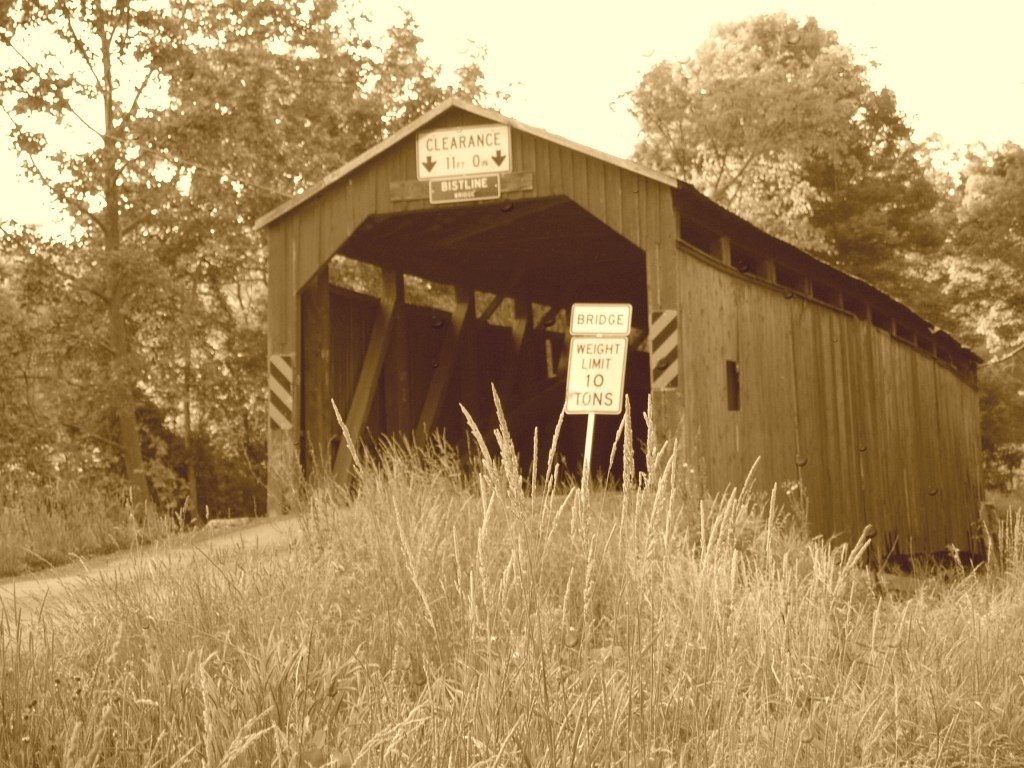
Bistline Bridge
For no reason, here is a picture I took of Bistline Bridge.
Style
A very wise person once said “It is comforting to know that although the moon is much smaller than the Earth, it is also much further away!”
Today I am gonna talk a bit about style. Not a spectacle of anorexic stick-figures strutting down a runway showing off clothes that no one can afford. I am going to make some comments on styles of beer. Beers are categorized by styles as a way to describe characteristics and to provide a map of what to expect for taste, color, thickness, etc. For example, the other day, I kegged a batch of “American Style Brown Ale”. This is an ale, brown in color with a malty backbone and an elevated bitterness. The BJCP defines it as:
19C. American Brown Ale
Overall Impression: A malty but hoppy standard-strength
American ale frequently with chocolate and caramel flavors.
The hop flavor and aroma complement and enhance the malt
rather than clashing with it.
Aroma: Moderate malty-sweet to malty-rich aroma with
chocolate, caramel, nutty, or toasty qualities. Hop aroma is
typically low to moderate, of almost any type that complements
the malt. Some interpretations of the style may optionally
feature a stronger hop aroma, an American or New World hop
character (citrusy, fruity, tropical, etc.), or a dry-hopped
aroma. Fruity esters are moderate to very low. The dark malt
character is more robust than other brown ales, yet stops short
of being overly Porter-like.
Appearance: Light to very dark brown color. Clear. Low to
moderate off-white to light tan head.
Flavor: Medium to moderately-high malty-sweet or maltyrich flavor with chocolate, caramel, nutty, or toasty malt
complexity, with medium to medium-high bitterness. Medium
to medium-dry finish with an aftertaste of both malt and hops.
Light to moderate hop flavor, sometimes citrusy, fruity, or
tropical, although any hop flavor that complements the malt is
acceptable. Very low to moderate fruity esters. The malt and
hops are generally equal in intensity, but the balance can vary
in either direction. Should not have a roasted character
suggestive of a Porter or Stout.
Mouthfeel: Medium to medium-full body. More bitter
versions may have a dry, resiny impression. Moderate to
moderately-high carbonation. Stronger versions may be lightly
warming.
Comments: Most commercial American Browns are not as
aggressive as the original homebrewed versions, and some
modern craft-brewed examples. This style reflects the current
commercial offerings typically marketed as American Brown
Ales rather than the hoppier, stronger homebrew versions from
the early days of homebrewing. These IPA-strength brown ales
should be entered as 21B Specialty IPA: Brown IPA.
History: An American style from the early modern craft beer
era. Derived from English Brown Ales, but with more hops.
Pete’s Wicked Ale (1986) defined the style, which was first
judged at the Great American Beer Festival in 1992.
Characteristic Ingredients: Pale malt, plus crystal and
darker malts (typically chocolate). American hops are typical,
but continental or New World hops can also be used.
Style Comparison: More chocolate and caramel flavors than
American Pale or Amber Ales, typically with less prominent
bitterness in the balance. Less bitterness, alcohol, and hop
character than Brown IPAs. More bitter and generally hoppier
than English Brown Ales, with a richer malt presence, usually
higher alcohol, and American or New World hop character.
Vital Statistics: OG: 1.045 – 1.060
IBUs: 20 – 30 FG: 1.010 – 1.016
SRM: 18 – 35 ABV: 4.3 – 6.2%
Commercial Examples: Avery Ellie’s Brown Ale, Big Sky
Moose Drool Brown Ale, Brooklyn Brown Ale, Bell’s Best
Brown, Smuttynose Old Brown Dog Ale, Telluride Face Down
Brown
Tags: standard-strength, dark-color, top-fermented, northamerica, craft-style, brown-ale-family, balanced, hoppy
WHEW! Quite a lot to think about there. The way I think about it is : A dark beer for sipping on while passing a pleasant evening interacting with my cats and reading a good book or watching a series. It has the taste of comfort and good feelings.
I know my definition is vague and very subjective but that is the way I think. Brewing beer is an art form. I make what I think will taste good and worry about classifying it after it is done, if ever. If I want something based on science and pure methods, I will turn on my ham radio (also very enjoyable).
As always, namaste!
Reflections (not the song)
Here it is, the day before a predicted storm and I am sitting here thinking about stuff. I like to watch science shows and learn from them, for instance, how the human genome includes around 2.5% neanderthal DNA if you are not of African extraction. Addictive personalities are caused by some of the genes. Neat stuff. Somewhere out there in the cosmos is a quasar pointed towards the Earth that might have fired off a gamma ray burst and will wipe us out. This event could have happened millions of years ago and might not hit us for millions more … or could hit tomorrow. Cats were once worshiped as Gods and still behave as if they ARE Gods. And here is something to ponder: on January 15th 1919 a tank holding 2.3 million gallons of molasses in Boston burst open and a wave of black sticky sweet molasses flowed through the streets at about 35 MPH, killing 21 and injuring 150 others. Life can be funny that way.
Adventures in Snowblowing
Anyone who lives/has lived in a northern climate knows the joys of having to clean up after a snow storm. Today I after I woke up, I had to do that. First we had to make a trip down to my mum-in-laws place ( a senior community) and clean out her car. The folks who run the place contract for someone to plow the main part of the lots and the sidewalks but they end up burying the residents’ cars, for the most part. Most of the residents don’t have the physical ability to clean their cars off and un bury them. We and other relatives of the residents go down there and clean up.
Once that was done we came back home. I had to purchase some shear pins the other day as 2 of them had snapped in my blower. I went to replace them and found a large rock wedged under the auger on one side. I was able to hammer the rock out of there and then I had to drive the broken pins out of the shaft. Once this was done, I got the blower started and did the clean up in my driveway and the walk up to the house. Gotta love winter!!
Confessions of a pet owner
Recently my wyfe and I have added to our pets. We each have hermit crabs on our respective desks. Hers are named Bowie and Hermie. Mine are Compo and Clegg. Hermits are nocturnal which makes them sorta interesting as they are most active when I am sitting at my radios and computer. I will have to post some pics at a later time. Right now I am trying to get the humidity up in my tank. It is currently about 75% and I would like to see it a bit higher. The temperature is good, stable around 80 F. I have some more tank essentials coming soon. Things for them to climb on and some spare shells for them to use as they get bigger.
We also have 4 cats, each of which has a story. Mote is our oldest at 7 years. He is a grey tabby. His mother, Mabel, left him on our back porch the day before she got killed by a car. We took him in and bottle fed him until he was ready to eat solid food. Mote is cuddly but only on his terms. Marley is Mote’s nephew. Marley looks like Mote except he is bigger … a lot bigger. He weighs almost 30 lbs. He is 6 years old and a real love bucket. Mayhem and Foggy are both 3 years old and from the same litter. Mayhem is a sweet little girl who is a very pretty torti and has a lot of personality. Foggy is a 3 legged turbo charged cyclone. He had to have one of his back legs amputated at a young age because someone kicked him (I have my suspicions but can’t prove it) and broke the leg at the hip. He gets around very well and is lively and entertaining.
That is my list of terrestrial pets. I will post pictures at a later time.
Prepping?
More and more, people are stocking up on food and emergency supplies. There is a huge market for emergency rations and other items. I wonder a few things. Are people keeping track of expiration dates? Are they buying rations that are already out of date? When their 2 weeks or 2 months of food does run out when the shtf, what are they going to do? Do they know how to forage? Do they know how to grow their own food? Can they skin and butcher the animal they just shot? Do they know how to operate that radio they have tucked away for the great breakdown? Can they protect their family and food supply from gangs of people who will be wandering around looking for victims?
These are legitimate questions and the time to think about them is now.
Brewing up some trouble
Today is Boxing Day which has nothing to do with this post. I am brewing up a batch of American Style Brown Ale. I am taking the time while it reaches a full boil to write this. Here is my basic recipe: 8 lbs Pale Malt, 2 lbs Munich Malt, 1 lb Dark Wheat Malt, 8 oz Chocolate Malt and 8 oz Crystal Malt (40L). For Hops I am using 1 oz Galena for 60 minutes and 1 oz Galena for 20 minutes. During the last 10 minutes of the boil I will add 1 tablespoon of Irish Moss and when the boil is done I will add 1 lb of Turbinado. For yeast I am using the Hornendahl strain. I mashed for 1 hour at 152F and collected 6.5 Gallons. My projected OG is 1.065. We will see. I will post my results later. Okay it is later. My OG is 1.056, a bit off them mark but not too bad. 🙂
A Christmas Post
Hi All. I am sitting here in front of my computer and radios enjoying the fleeting company of my cats as they jump on and off of my lap at various intervals. Now there are a lot of theories out there about why Amateur Radio Operators are known as hams. Here is an article that seems to have a ring of truth about it:
** Why an Amateur Radio Operator is called a HAM **
By Gerry Crenshaw (WD4BIS)
(This was previously published in the Amateur Radio Communicator MARCH/APRIL 1994)
Have you ever wondered why we radio amateurs are called “HAMS”? Well, according to the Northern Ohio Radio Society, it goes like this: the word ham was applied in 1908 and was the call letters of one of the first Amateur wireless stations operated by some members of the HARVARD RADIO CLUB. There were Albert S. Hyman, Bob Almy and Peggie Murray. At first, they called their station Hyman-Almy-Murry. Tapping out such a long name in code soon called for a revision and they changed it to HY-AL-MU, using the first two letters of each name.
Early in 1909, some confusion resulted between signals from Amateur wireless HYALMU and a Mexican ship named HYALMO, so they decided to use only the first letter of each name and the call became HAM.
In the early pioneer unregulated days of radio, Amateur operators picked their own frequency and call letters. Then, as now, some Amateurs had better signals than some commercial stations. The resulting interference finally came to the attention of congressional committees in Washington and they gave much time to proposed legislation designed to critically limit Amateur activity.
In 1911, Albert Hyman chose the controversial Wireless Regulation Bill as the topic for his thesis at Harvard. His instructor insisted that a copy be sent to Senator David I. Walsh, a member of one of the committees hearing the bill. The Senator was so impressed, he sent for Hyman to appear before the committee. He was put on the stand and described how the little Amateur station was built. He almost cried when he told the crowded committee room that if the bill went through, they would have to close up the station because they could not afford the license fees and all the other requirements that were set up in the bill.
The debate started and the little station HAM became a symbol of all the little Amateur stations in the country crying out to be saved from menace and greed of the big commercial stations who did not want them around. Finally, the bill got to the floor of Congress and every speaker talked about the poor little station “HAM.”
That’s how it all started. You will find the whole story in the Congressional Record. Nationwide publicity associated station HAM with Amateurs. From that day to this, and probably to the end of time, in radio, an Amateur is a HAM.
GL and 73’s de Gerry WD4BIS
Copyright 1996 Gerald Crenshaw WD4BIS. All rights are reserved.
This may or may not shed light on the subject. I do know that most hams carry the title with pride. Now here is a link to the Harrisburg Radio Amateur Club website announcement and flyer for the hamfest coming up on 8 Jan 2022. http://www.w3uu.org/winterfest/
Hamfests used to be a big attraction. A combination social gathering and radio-related flea market. Toss in some good food and/or snacks and you have a winning idea. Unfortunately, the internet has eroded the support for hamfests. I still like to go and look around and will be at the Winterfest.
I have everybody has a happy holiday season.
 Nature, Radio, and Me