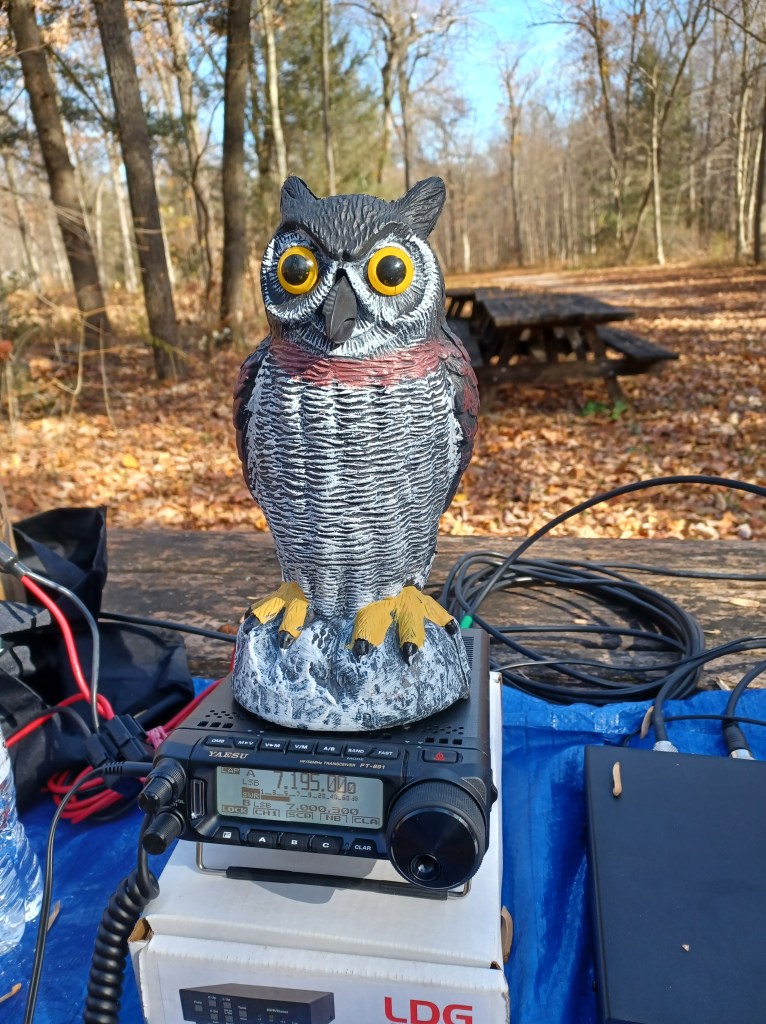
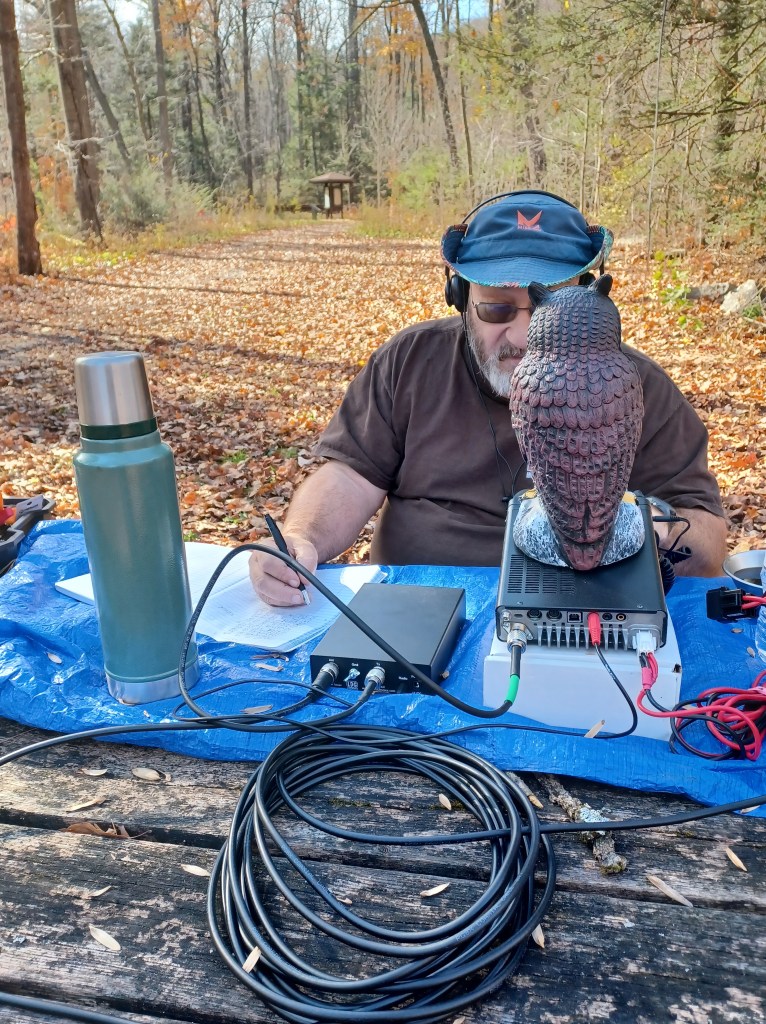
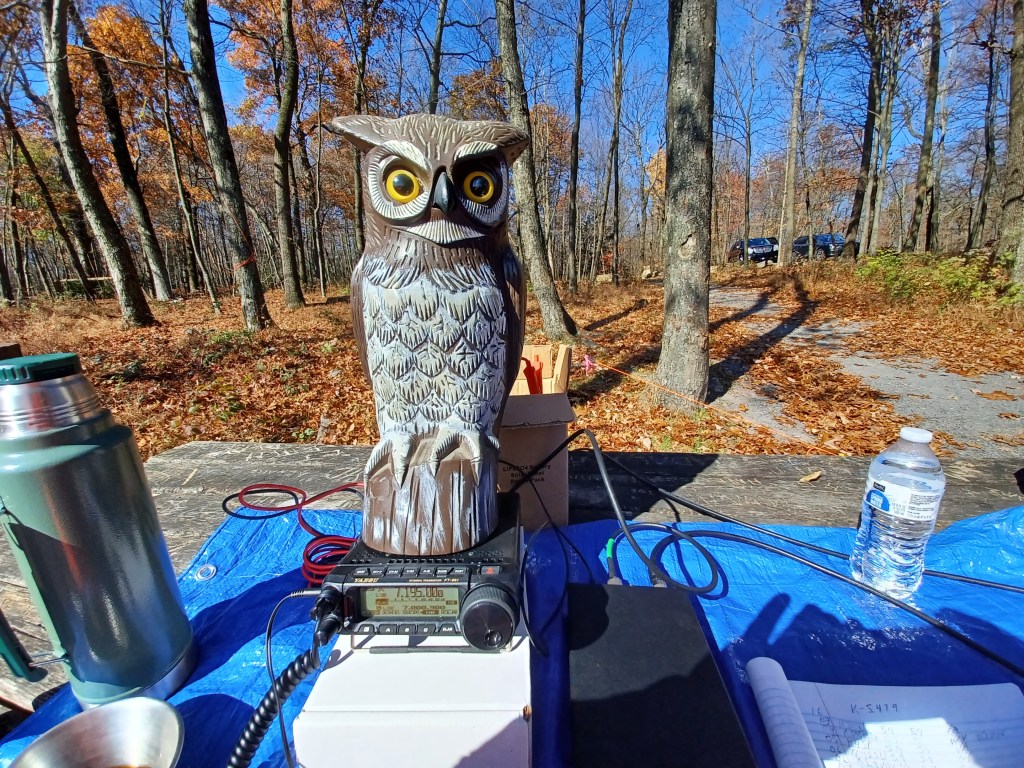
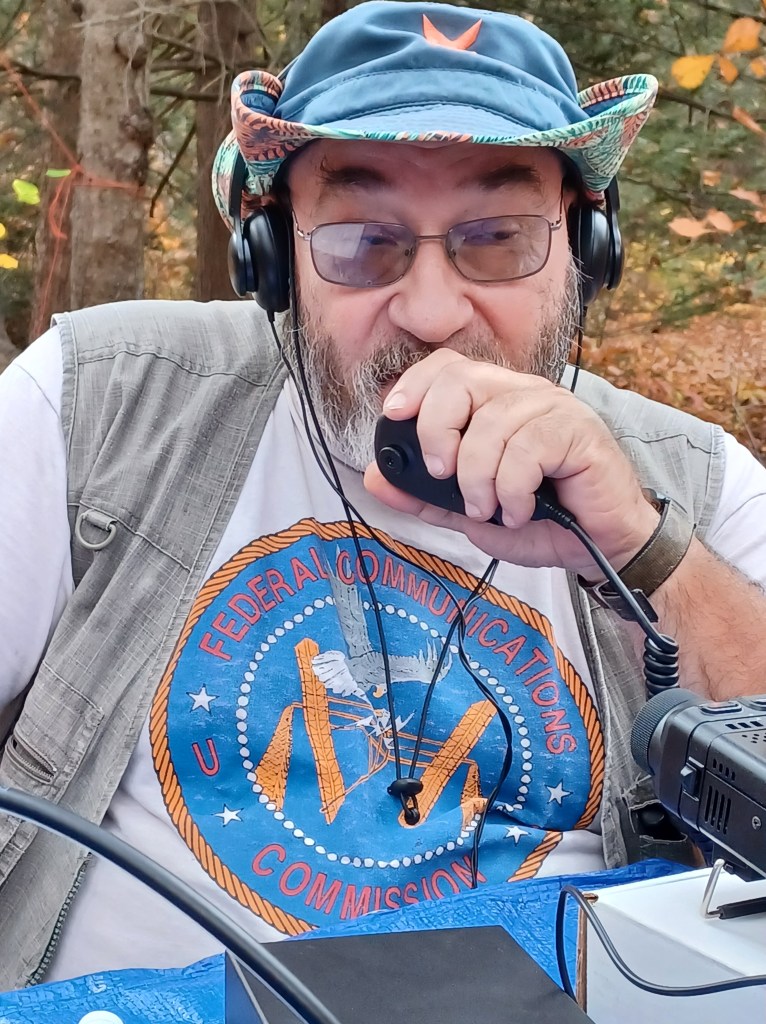
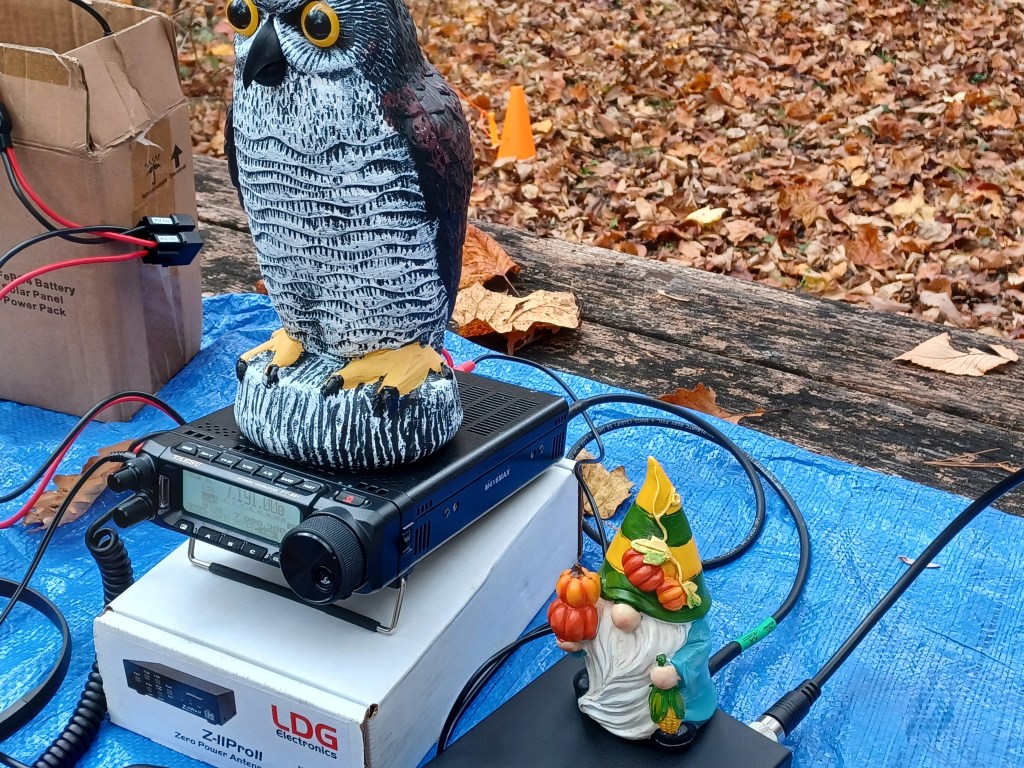
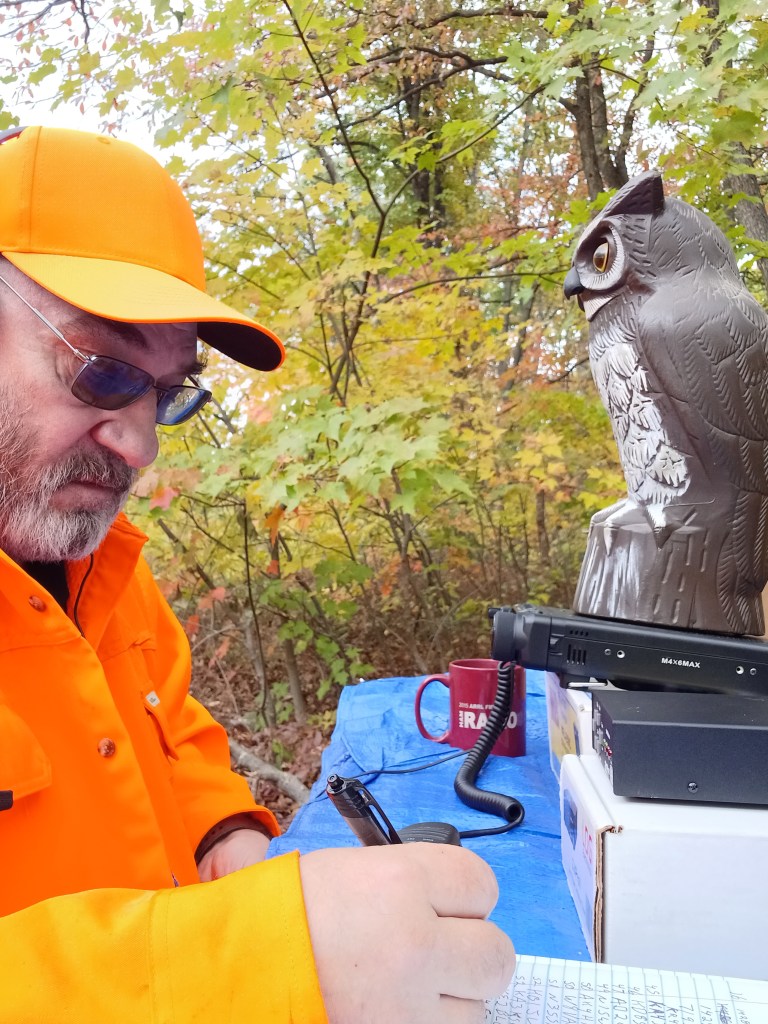
Wow! What a gorgeous day! It was too good a day to waste so I set out to do an activation. All too soon I will be trapped inside by the weather so I am taking advantage of every day that I can. Today, 7 November, it was in the mid 70’s F(low 20’s C) and mostly sunny. The only bad thing about the whole day was the almost constant barrage of large pine cones falling on and around my operating location. I got my antenna up in the tree with very few issues and was on the air. I got off to a bit of a slow start but soon made my 10 contacts. I sat there drinking coffee and playing radio in the sunshine for about an hour and totally enjoying myself until the realization of life intruded upon my zen. I had some adulting to do. I made a total of 45 contacts within an hour so I called it a day. Again, thanks go to those who hunted me and to my long suffering wyfe who puts up with me and to my owl, Tootsie who kept away the lions and tigres and bears. Until next time, kidlets, namaste.
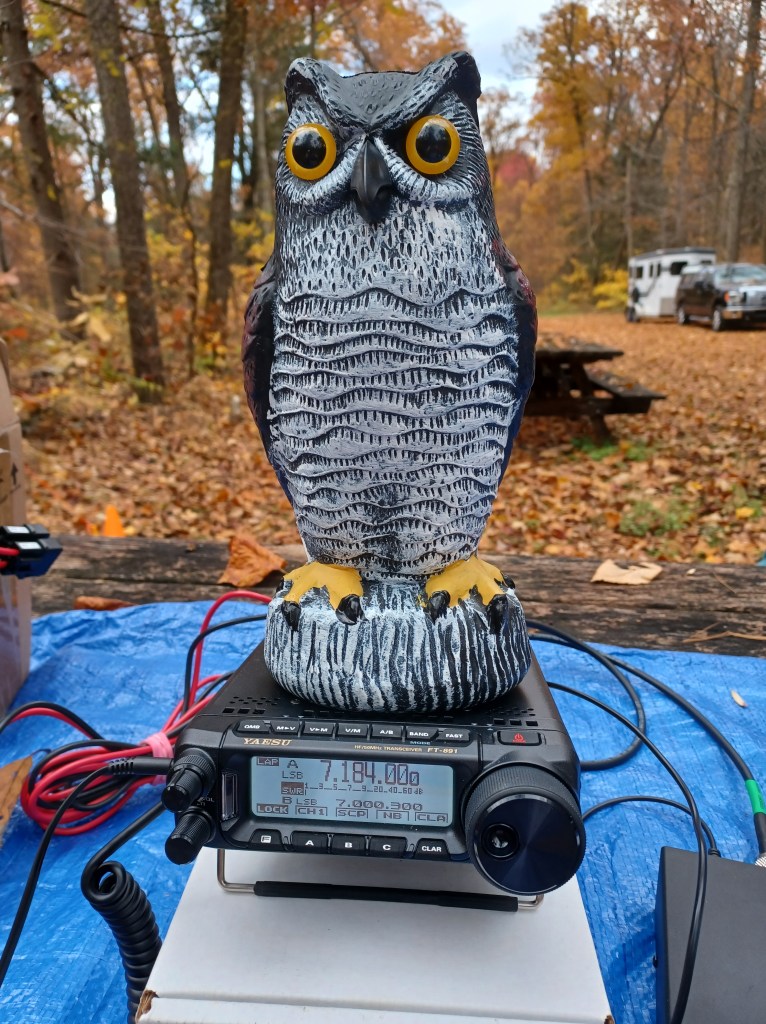
Tootsie Standing guard. He’s got my 6.Another one in the logLeaving no trace.
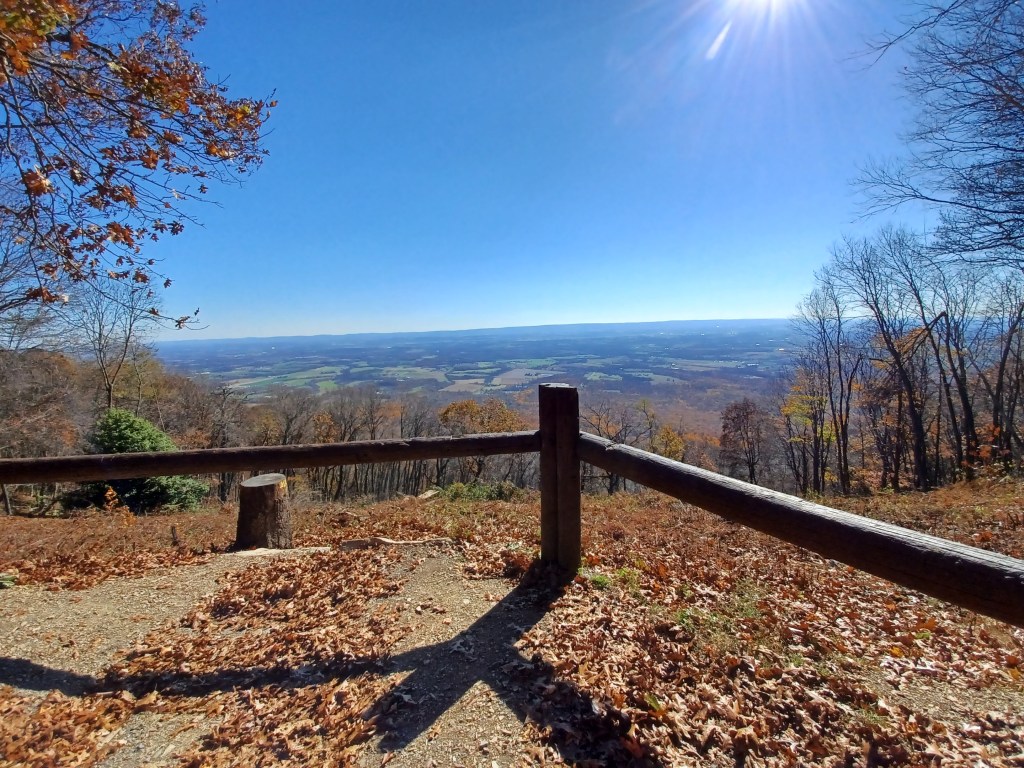
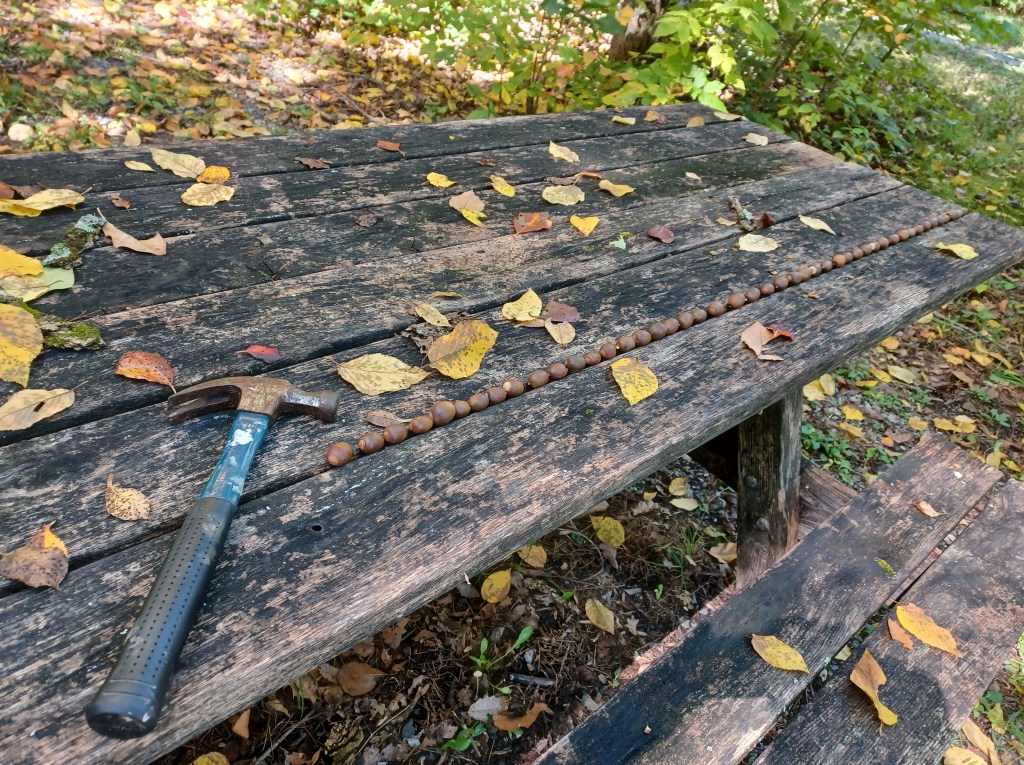
Well no shit, there I was, up at the Three Square Hollow Vista in Tuscarora State Forest setting up for an activation. It was a nice sunny day today albeit, there was a chill wind blowing. Anyway, I threw my arborist bag up over a convenient tree limb and, sure enough, the damn thing wrapped around it 6 times. Uttering several words that would cause any residual green leaves to turn various shades of colour, I tied my hammer to the other end of my throwing line and proceeded to throw it over the branch to unwind the wrappings. as I was partway through this operation, a vehicle pulled up next to mine and a couple of hunters got out. They came over to me and asked me about ham radio and went about their business of using their cell phones as this is one of the few spots in this area of the mountain that has reception. I got my bag unwound and got my antenna raised up. They asked a few more questions and seemed surprised that I planned on using such a small piece of wire to talk to people all over the place. I assured them it would work. They then took their leave and drove off. I sat down and hooked up my rig and made 33 contacts from CT to MI to SC to ON over the course of the next 45 minutes. The main problem was the wind blowing directly on my back. It was chilling me right through. If it hadn’t been for that I would have stayed longer. I am not looking forward to the colder weather coming but will continue to try activating as much as I can until it just gets too bad. I am including a picture of Zarathustra monitoring me and the view over my shoulder. In any event, Namaste until next time, kids.
Zarathustra keeping me in lineThe view behind me overlooking Cumberland County, PA
It was the best of times, it was … actually pretty good. even the bad was good. We went out on the 24th, Tuesday October 24th, for those who were wondering, and the weather was beyond compare. Sunny and in the mid 20’s C ( mid 70’s for those stuck in the F scale, mid 290’s for those who prefer K). Not much wind. My antenna went up easily , almost like it knows where it is supposed to go. The contacts started rolling in very quickly and in no time I had worked a total of 43 including some park to parks and a couple husband-wyfe teams. a good day. After packing up, my wyfe and I took a ride up Hemlock Road and she did some videoing before we went and got some lunch/supper (lupper?). My owl decoy, Tootsie, kept the bears and Karens away and generally helped me log. The park is one of the nicest places a person can go; remote and quiet with a wooded charm.
Yesterday, 28 October, my wyfe said that maybe I should take advantage of the weather and activate as rain was supposed to move in today. As you may be able to tell, I am doing my best to get as many activations in before the weather turns shitty for the next 3 months. I like the outdoors but sitting out in the cold doesn’t appeal to me much these days. I guess I should explain that I am a neophyte when it comes to POTA. I only started doing this with any seriousness this summer. Sure, I had worked a few parks before this and I had registered on the POTA website in April for 2022, but I never really made any effort until this past summer. I started hunting and then I started doing activations. I am no expert by any means, though I have a lot of experience doing portable operating. In fact it is good to be getting back into it. Ok. Enough history. Yesterday I packed up the car and brought along Ptolomey as my mascot/guardian. I also brought my pink flamingo, Charade. It didn’t take long to set up but it did take a while for my first contacts to come in. I thought it was going to be hard to get 10 but finally they started gaining momentum. I started getting spots on the POTA APP and I was able to work 54 contacts with a lot of Park to Park contacts. Overall, though the day was a bit cloudy and dismal and the temps were a bit lower than Tuesday, It was a good day. Hopefully there will be more chances this Autumn.
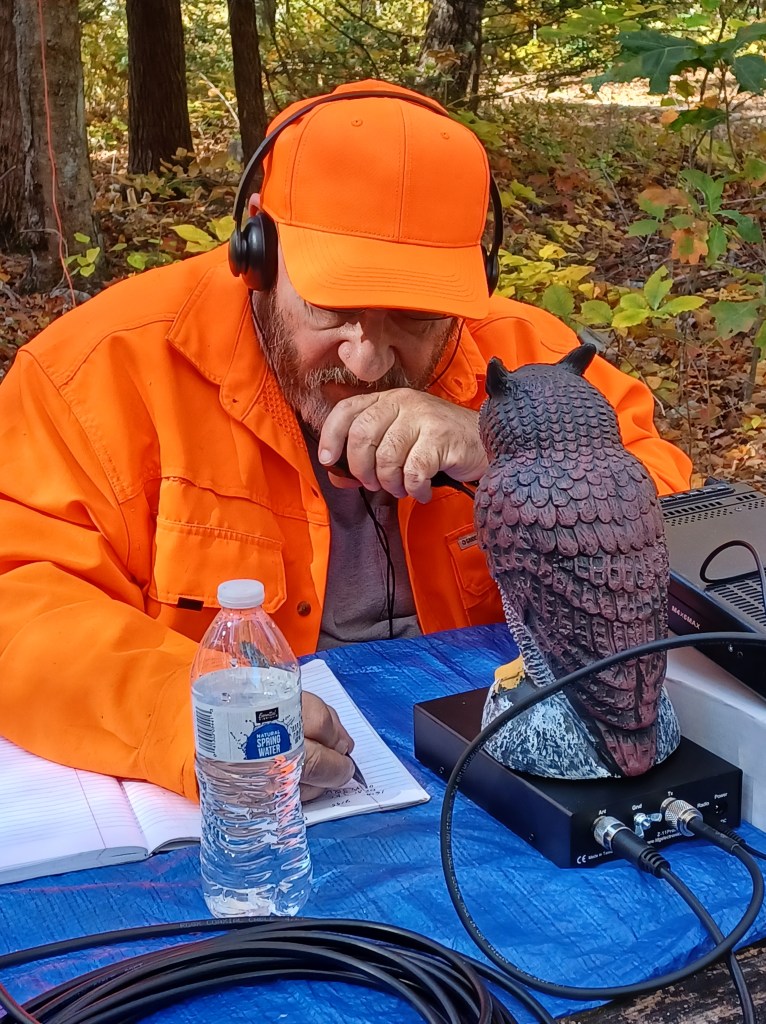
Tootsie watching over my shoulder.Logging under the careful supervision of Tootsie.Ptolomey being a proper guardian.Working another contactGot visited by a curious forest gnome.
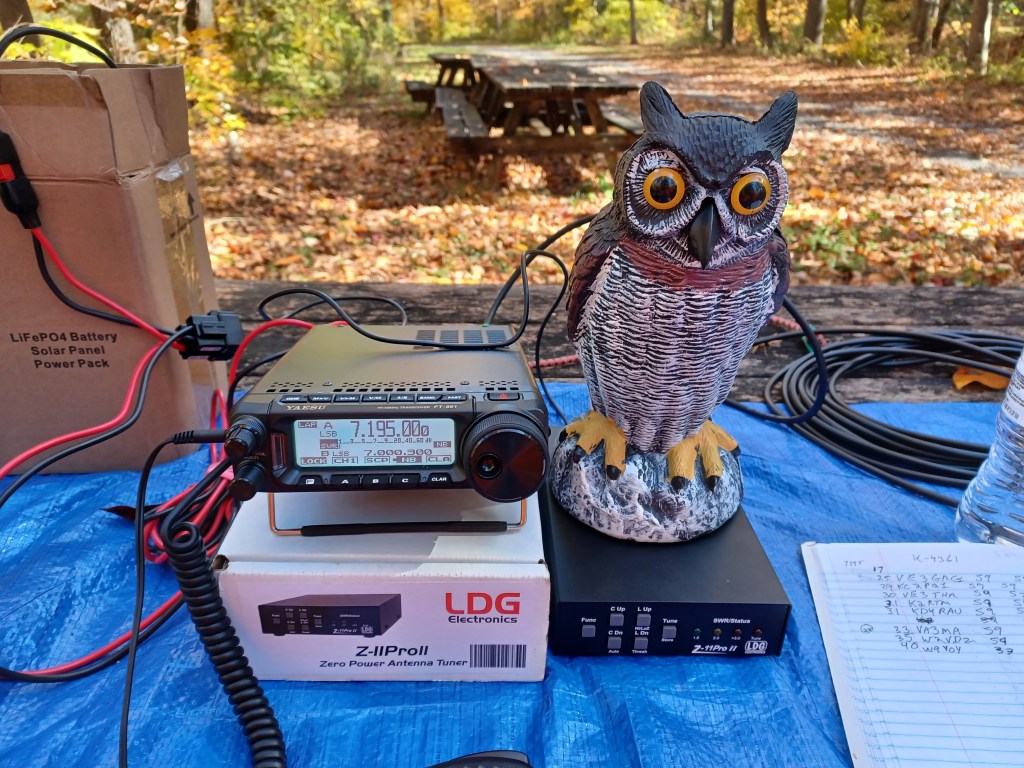
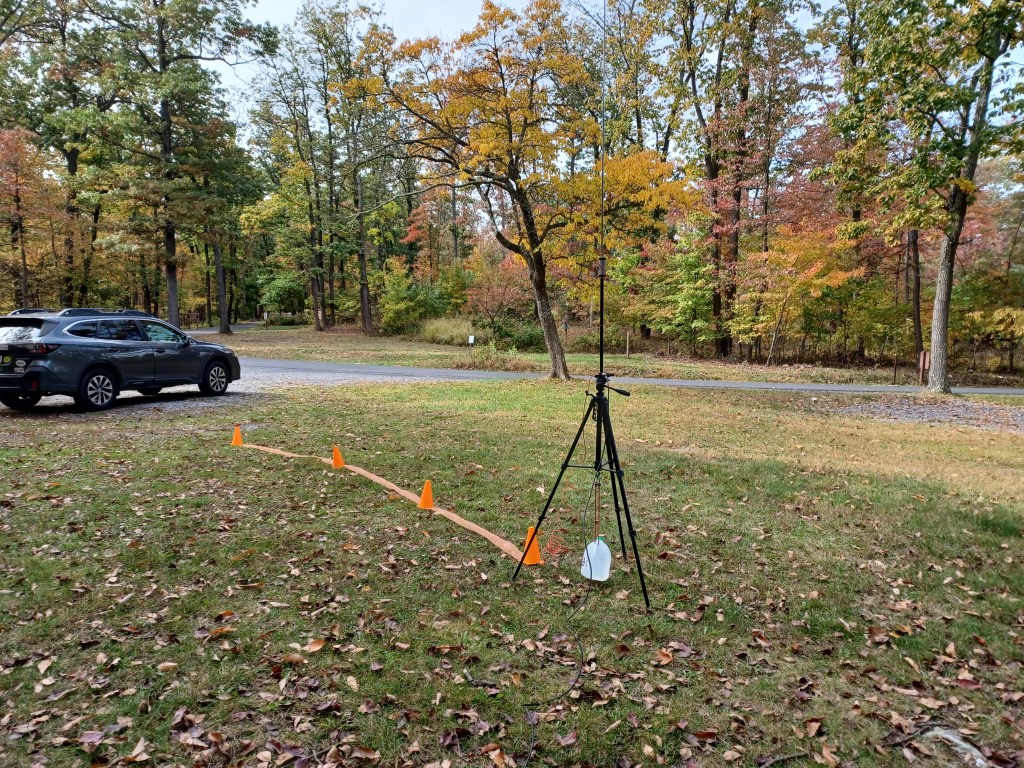
Yup. did another activation today. We took a drive on the spur of the moment up to Kings Gap Environmental Education Center (POTA K-4361). You might have surmised that we sorta-kinda like the place. What’s not to like? A peaceful hilltop in a verdant setting where any noises are muffled by the trees. Today there were 2 bus loads of public school kids and 4 van loads of Mennonite school kids participating in a school program and we didn’t even hear them from where we were parked. As to my setback … well, it was a lapse on my part. I got my antenna set up and ready and then put my rig out and connected it to the tuner and went to make the final connections to the battery and LO! and BEHOLD! I had left the pigtail that goes from the power pole connectors on the rig to the battery at home! Luckily, I had spare connectors, wire, alligator clips and crimpers in my radio box. I rigged up a pigtail and was soon on the air. The antenna I was using was my Buddistick. I had it mounted on a tri-pod and was using 6 meter by 10 cm copper mesh strip as a counterpoise. It worked pretty good on the 40M band though it did not out perform my usual inverted vee setup. I made 30 contacts varying from CT to MI to the Carolinas to Ontario. I will try this again to make sure it wasn’t just the day. I will also try this setup in one of the other parks I have activated before and compare notes. I will have to keep an eye on the weather but I may activate on Tuesday, either Big Spring or possibly Little Buffalo State Park. I am not looking forward to colder weather and am planning on squeezing in as many activations as I can before I am forced to stay inside until the area gets more hospitable. Well my coffee cup is empty so I think I will end this for now and will post a few pictures to include the owl of the day, Zarathustra. Picture 1 is my Biddistick. Picture 2 is Zarathustra supervising my logging. You kids behave. Namaste.
It has been a busy month, I guess. I have really been into the whole POTA thing and between that and work and keeping my life from falling into the usual chaos, it has been one amazing fun filled blur. I mentioned in my last post that I had activated 2 parks on 3 September. Well, just the other day, 1 October, I went out to the same place, Big Spring State Park, located in Tuscarora State Forest and activated again. I made a total of 49 contacts in an hour including several park-to-park contacts and was able to withstand the constant bombardment of acorns falling from the trees. It was a beautiful early autumn day and I was very happy to be out and about. I will include a picture or 2 below. I prefer to go out on nice days as I do not want my radio rained on. There are pavilions I could use, I guess but I do prefer the open air and sunshine. It doesn’t take me long to set up and I can be on the air within 15 minutes of pulling into the park. I prefer to use a G5RV Junior antenna as it is a good multi-band antenna and works well as an inverted vee. Right now the only limiting factor in my setup is my power situation. The battery pack I use just isn’t up to the job which is why I am going the pick up a LiFePo 12V 20ah battery tomorrow which will allow me to run my rig for a much longer period of time. You can expect a more contacts listed from my next activation report. well kidlets, enough for now. Namaste, you’all.
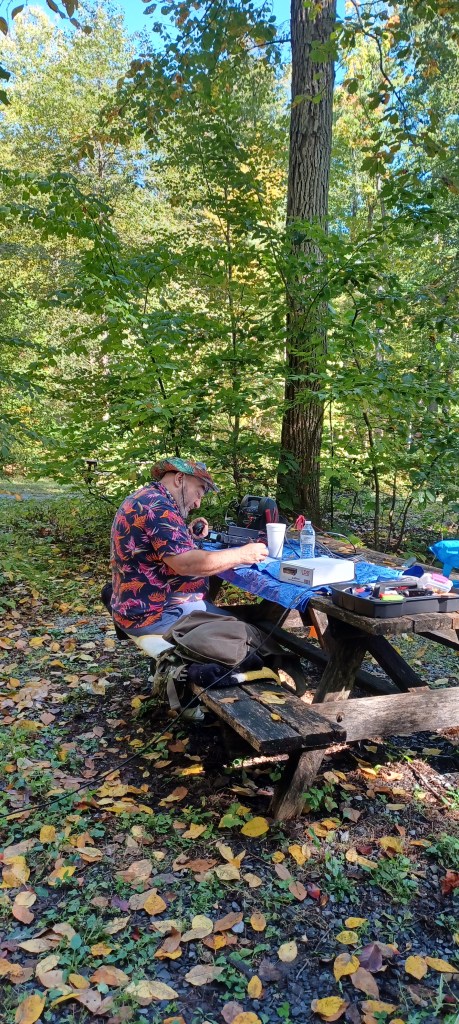
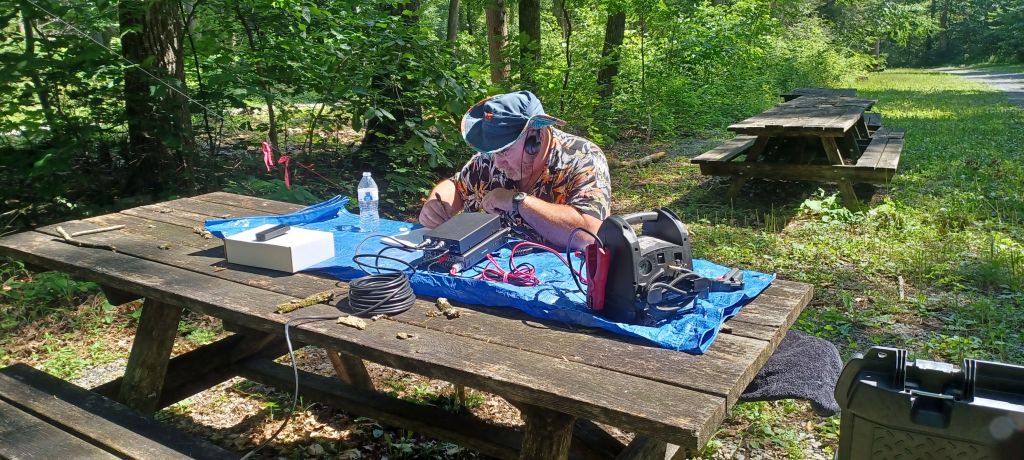
It was a great day today. The weather was beautiful and it was a very nice day to be off. One of those Sundays that come along once in a while that make you want to go outside and do things. Today my wonderful wyfe and I went out to a State Park about 15 miles down the road and did a POTA activation. POTA stands for Parks On The Air and is a program for ham radio operators to get out and be active in the public, operating in State and Federal parks, Forests and Game Lands. The park we were at was Big Spring State Park ( POTA Number K-4355) which is located on the western edge of Perry County PA. As I said, it was a beautiful day. It only took me about 15 minutes to set up. I put up an inverted Vee antenna with the apex up about 30 feet. My radio is a Yaesu FT891 and I was using my new LDG Z11 Pro II tuner. The setup worked great and I was able to make 26 contacts in less than an hour of operating before the bugs drove me out of there. In the meantime, my wonderful and long suffering wyfe was enjoying herself making videos of nature and of me operating. All in all, a good time was had by all. Following is a pic of me operating and my setup. The random hunks of tree bark on the table were still there when we left. 🙂
Today the weather turned out nice. It started out rainy but then turned sunny. I was able to beat Satan’s Putting Green into submission and we planted some gourd seeds in the hopes of obscuring part of the yard in vines for most of the Summer.
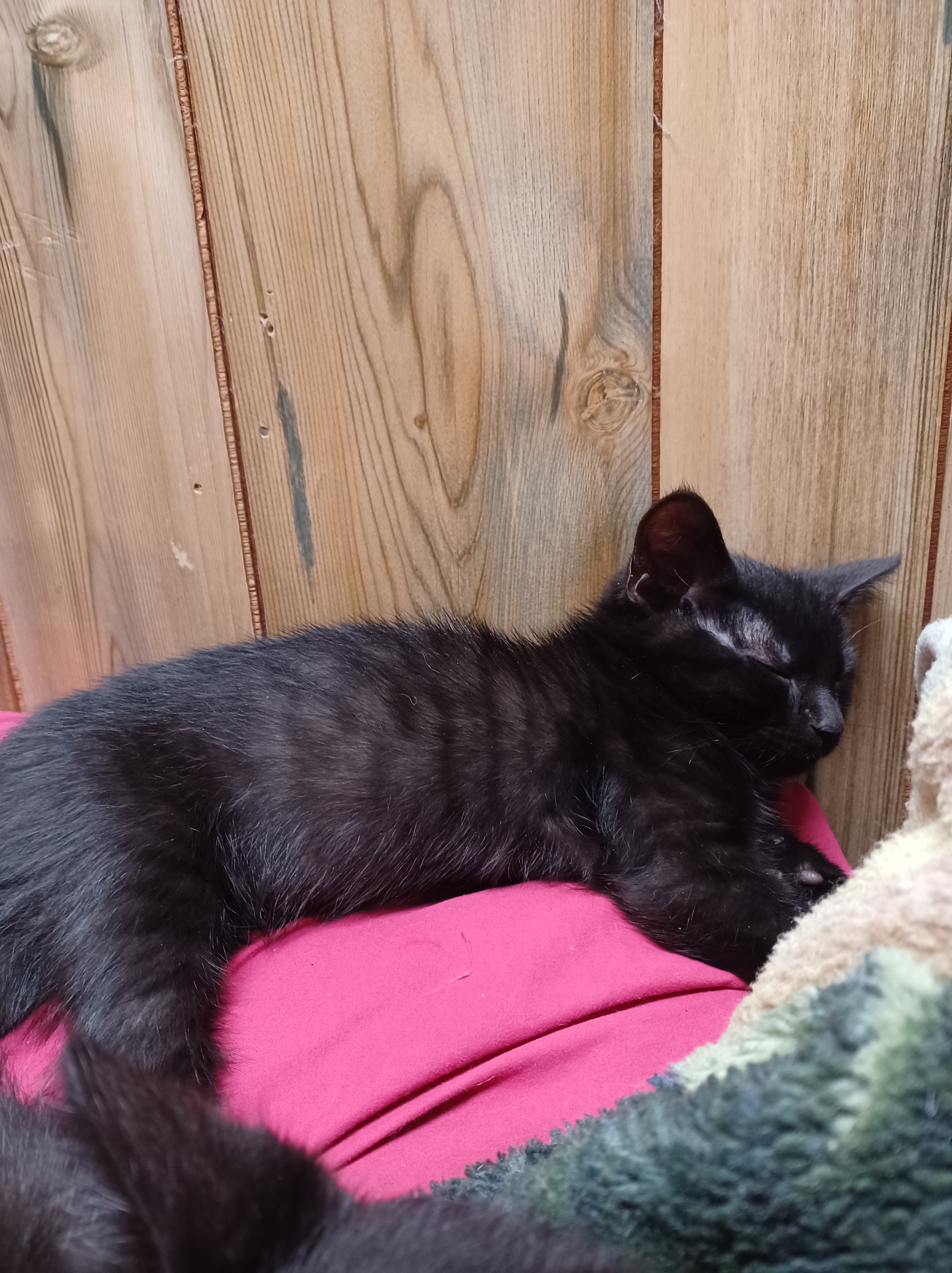
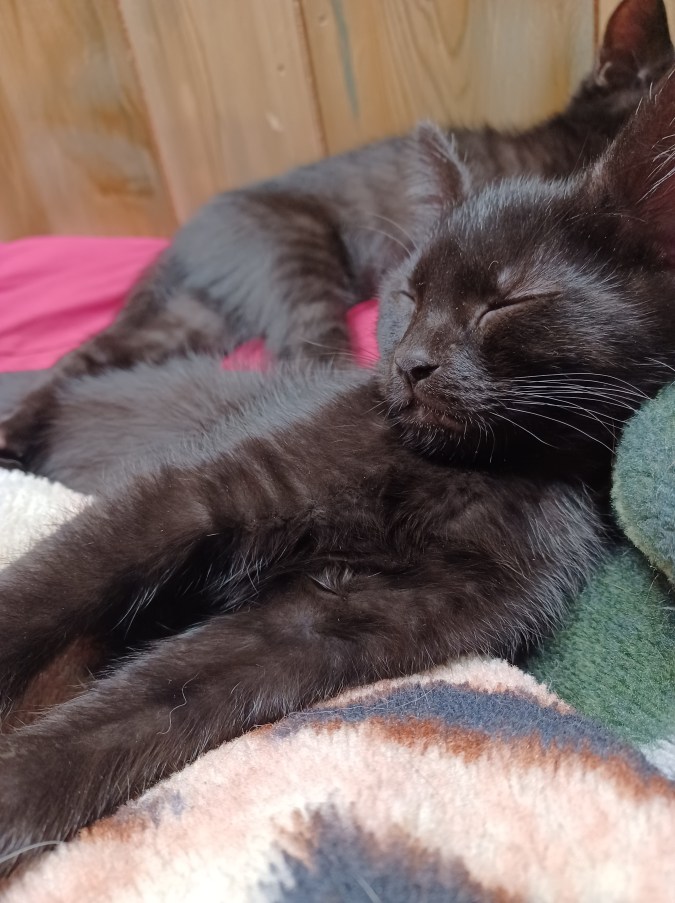
A funny thing happened this past Saturday. My wonderful wyfe has been wanting an all black kitten for ages. I finally found her one. After doing some schedule juggling we arranged to meet up with the nice lady who had such a kitten and she brought us a choice of 2 10 week old all black male kittens. Of course we took both of them. Meet Dipper and Kalamazoo:
Trust me, they are a lot cuter in person.
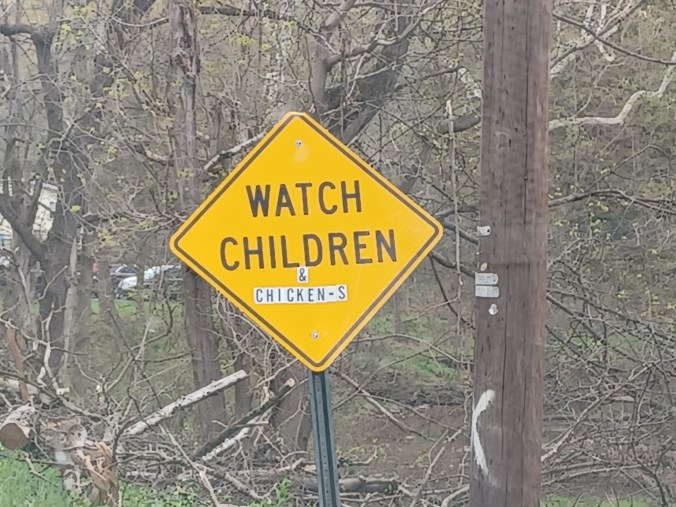
I have also come to the realization that I really do live out in the sticks. Here is my proof:
Soon it will be time to start thinking about getting outside more and enjoying the warmer weather …. until it is 95 degrees Fahrenheit ( for those who still use that system, I prefer 35 degrees Celsius) with a relative humidity of about 85% then you will want to lay about in the AC and bitch. Actually I was out yesterday with my new radio and a G5RV Junior playing around. First off I was learning the foibles of tuning this set up as an inverted vee. I didn’t want to have it set up in too permanent looking a configuration as I was in a public location. Second, I was learning the menu system of the radio as so far I have not had a lot of time to use it. Third, I was fine tuning my grab and go style. Back some years ago I could have a portable QRP station up and on the air within 15 minutes of pulling into a location. Yesterday it took me over 40 minutes to get on the air not including having to return home to get my power supply (turning red with embarrassment). I am not as readiness able as I used to be, I reckon. Guess I just need to practice. My plans for the future include bringing alternate antennas to try out. One nice thing is that my wyfe is willing to assist. She enjoys coming along for the ride and likes to laugh at my mistakes. 🙂 In any event, I will keep plodding away and keep posting here. For now, namaste, y’all.
Here it is again, the middle of March. We went for a bit of a ride but the animals were not cooperating. It is currently 2 C outside with the winds between 10 and 26 KPH so I think the ruminants are huddled in the treeline wrapped up in squirrels and robins for warmth. Typical March weather in the Northeast.It is okay, it gives me an excuse for idleness on my day off. I can sit here drinking coffee and listening to folks on the ham radio bands. The stove is running well and keeping it nice and warm in here. I am trying to work a special event station celebrating National PI Day but not having luck so far. They are located in NJ but are right now on 20M which is a bit long to reach here. Hopefully they will QSY to 40M sooner or later. My cats are behaving which translates out to they are asleep. Overall a good day. I have an appointment tomorrow at the ophthalmologist so that I can be informed that my retinopathy has progressed and my cataracts are a bit bigger. It is a yearly ritual; almost pagan in nature. I think I will relapse into a semi-vegatative state for now and lose myself in the comforting white noise of 40M.
Wow! I am sitting here yawning and it is only 1623 est. Even copious amounts of coffee don’t seem to help. It is -2 C outside … the kind of day you want to sit inside and do inside things. I was on the radio for a bit, chatting with a few folks after i did my due diligence on my exorcise bike. My wyfe joined me and we spent the time killing things on the video game. It is a great way to distract yourself when you are exorcising. Now I am sitting here contemplating my next course of inaction. My kittehs are all snoozing in the warmth of the stove so I can’t interact with them. My wyfe is cocooning. Well I guess I will have to get back on the radio and see if I can scare up any more people to bother. I am getting a lot better with the cootie key which is a lot easier on my arm. I think it was a good purchase.